




SERVICES
ORGANIZATION PERFORMANCE TREND ASSESSMENT
FOUNDATIONS OF WORK
ORGANIZATION PERFORMANCE TREND ASSESSMENT
FOUNDATIONS OF WORK
ORGANIZATION PERFORMANCE TREND ASSESSMENT
FOUNDATIONS OF WORK
ORGANIZATION PERFORMANCE TREND ASSESSMENT
FOUNDATIONS OF WORK
Fostering excellence through a refined approach to working.
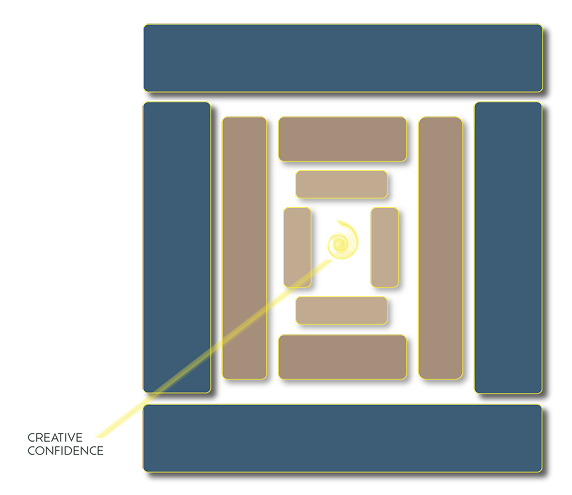
Individuals and teams activate creativity and efficiency as a deeper resource for their organization. This associates the relevance of daily work tasks to the momentum they create for their organization.
Details: Client selects a cohort or team to participate in FOW. The group will participate in a four-week experience divided into three parts.
After the four weeks, the client will receive a progress summary that details working mode shifts. The summary will include shifts between individual working modes, team collaboration, and personal awareness of skillset development.
Providing a better understanding of the behavioral health of an organization.
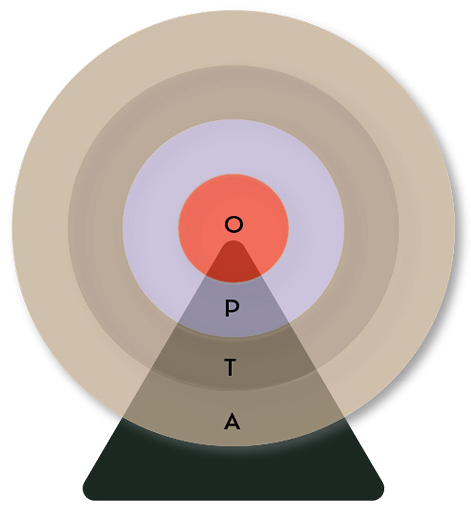
The OPTA identifies performance trends and opportunities to help organizations make more streamlined and directed decisions.
Details: ANOV will spend one week in a client’s office guiding people through the assessment with series of workshops and individual interviews. The OPTA © process looks at the connections between the following three groups;
After the OPTA week, the organization will receive an OPTA © Summary that details the performance health from baseline to advanced. This includes rankings on motivation, ambition, environment and resources and the strength of connection between the three groups on the following factors; communication, collaboration, planning and adjustment.
And some other fun stuff you will have to wait to see…
When career safety is the priority, what do we lose?
What does it mean to be safe in a job/system/country/world with threats on all fronts?
Does it mean one is safe if there is a fortress built around oneself, so nothing can ever shake it down? Is one safe if one plays “small” and is agreeable beyond recognition? Is one safe if they align themselves to the perceived powers that be, hoping they will be protected with enough power and money that they can avoid any harm done to them directly? How safe is that, really?
Within organizations, ANOV prefers to take a more direct approach – Durability. This was first introduced by Larry in our POL#1 in terms of career growth. Durability is the ability to exist for a long time without significant deterioration of quality or value.
A rock is considered durable, and so is the ocean. It is so dynamic and flexible and ever-changing that it can carve through the middle of a rock. It is also safe unto itself, working within an ecosystem that adapts to changes manmade-or otherwise. It does not look for safety outside itself; it instead looks inward to build durability through action and adaptation.
Silk flowers are durable. They are created with perfection at the center point of their existence. They are expensive and will look the same no matter where one puts them in their home. But, they collect dust. They will always be as we expect them to be, but eventually everyone gets sick of their perfection and throws them away. Static perfection does not make them safe.
Now, a real houseplant: possibly procured at the farmers market on a sunny and optimistic Saturday, it is borne from natures perfection. A more mature plant is strong enough to sprout again, but this baby house-plant can be temperamental. Provide enough sun, but not too much. Provide morning light, indirect light, but never afternoon light. Maintain a regular watering schedule that changes with each season, dependent on where you live. A base level of knowledge is required to keep it alive, and also continual attention to its silent needs.
However, if it is nurtured it will grow and change every day. And, the reward is magnificent. It is beautiful in its imperfection and in its care from (you) the caretaker. It is quite durable, but that durability only comes from attention, awareness, and adaptability. Just don’t ask my compost bin to keep score for my house-plants!
Similarly, many of us in the western world could consider adapting our thinking when it comes to how they build durable career. For generations, if you followed the expected formula (If x, then y) you would be “safe” in your career. But our modern world, should adapt that formula (if x , y, & z then possibly A).
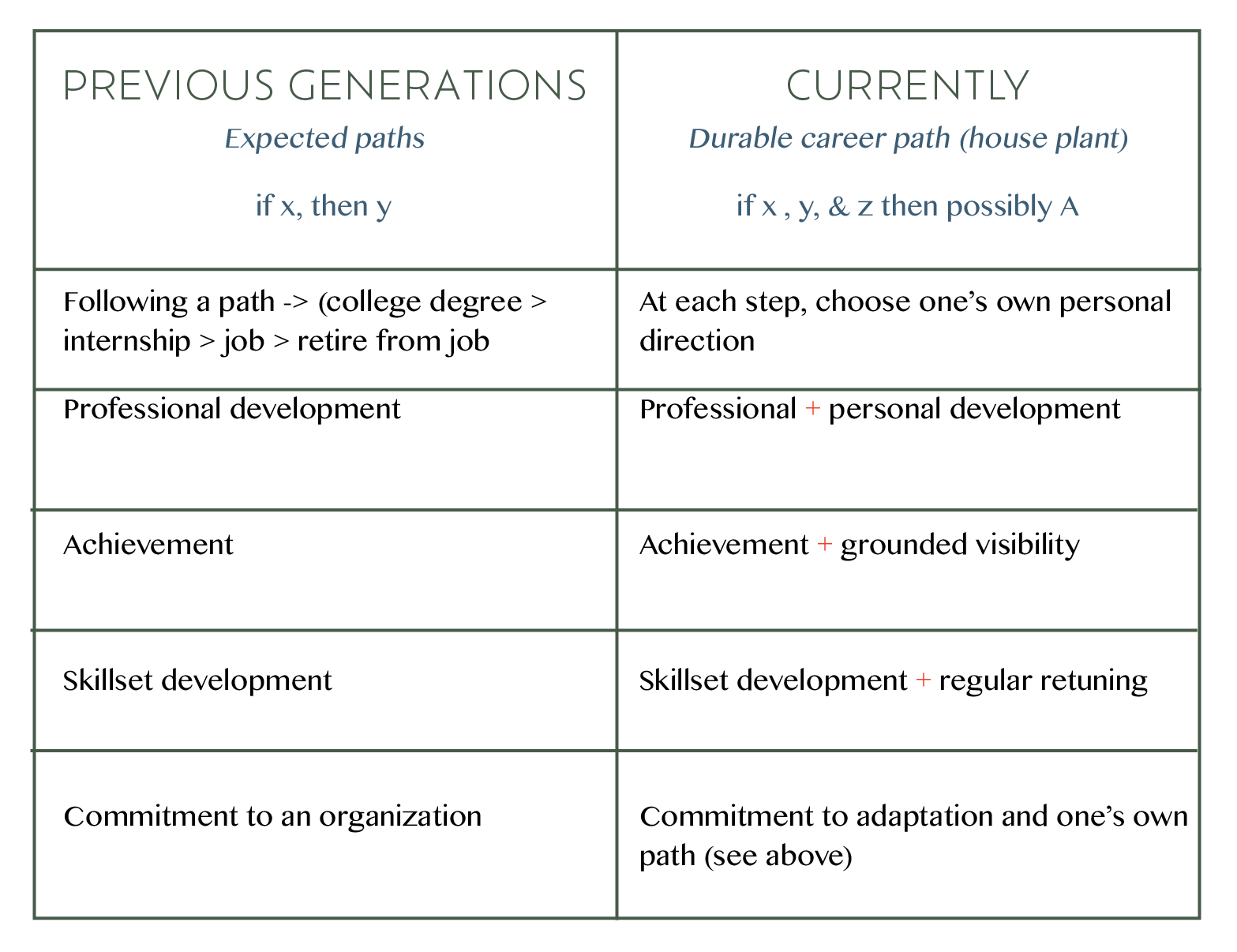
Not to say that one is fake (silk flowers) and one is real or better… but what makes something durable is its ability to change and our ability to nourish it. To withstand the changing seasons (strength), to invest in oneself (nourishment), to expand into a bigger pot (growth) and navigate the beauty and the lessons in it all (uncertainty). The durability comes from the cycle;
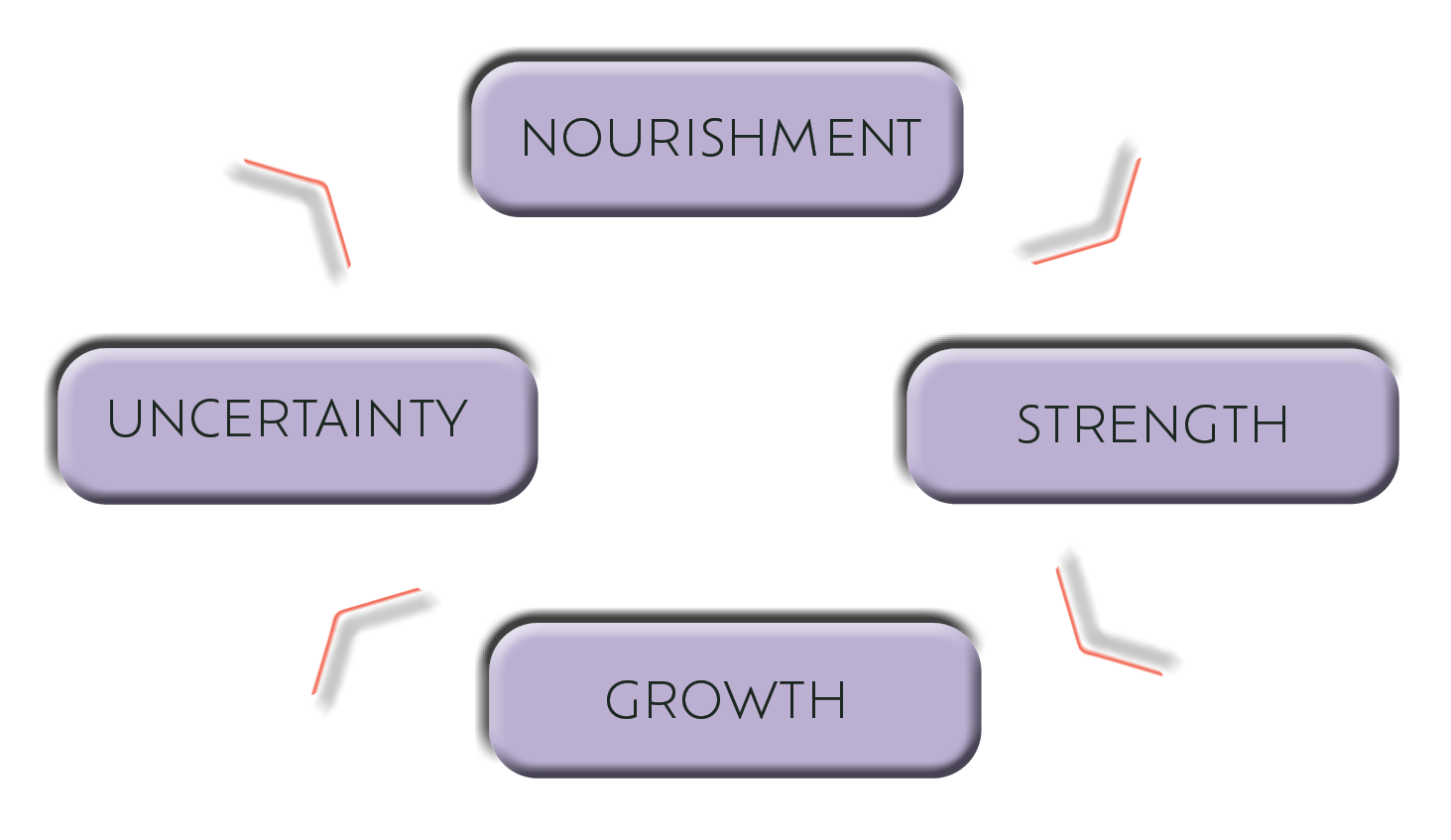
It’s important to note that my own path building a durable career has rarely felt “safe”. It has included shifting targets that I couldn’t always keep up with, developing skillsets that I knew would one day be obsolete, lots of talking and very little action, nourishing ego’s that did not protect me, over 333+ rejections, and a complete re-start (more on that in the future).
Following the path of safety didn’t work for me. Nourishing myself both personally and professionally did.
Which is why, at this point I can say that I have created a durable career for myself. I have no certainty of what will happen, and it will be mostly imperfect, but it will never deteriorate the value or the quality of my time.
The dynamic tension of artists splitting their focus on promotion and creativity has parallels to ‘moving up’ in a career.
Is it better to have a massive fan base, or to truly express unique creativity in relative obscurity?
Career development has parallels to artistic development. Yet, career durability is more reliant on deep development across many areas, rather than quick ascension based on pleasing people.
Advancing in a professional career has changed significantly in the last decade. The classic professional “promotion” appears to have morphed into the actual definition of the word: ‘active encouragement for the furtherance of a cause, venture, or aim’.
ANOV’s view is that magnification – rather than “promotion” – better encompasses personal elevation. Magnification embodies a collateral effect of broadening an individual’s beneficial impact on their organization.
But beyond semantics, ANOV has a different perspective on upward mobility.
Rather than seeing a promotion as a centrist approach to an individual’s rise in an organization, we take a holistic perspective of interdependent growth potential and how it influences team performance and long-term achievement.
Because all too often, the tipping point of being promoted is a judgement of genial personality, rainmaking potential, and indiscriminate conformity. Such factors are relatively easy to discern.
What are often less obvious are leadership abilities, work quality, unique skills, and regularly applying creativity – all in service of having a meaningful and lasting impact on external clients and internal team advancement.

So, to the analogy of Taylor Swift and Todd Rundgren; two ‘popular’ music-making legends and how they may represent a reasonable analogy of career ‘promotion’ versus career magnification.
Taylor Swift needs no introduction. As a musician and popular entertainer, she is a worldwide phenomenon and has more broad generational appeal than any contemporary musician since the turn of the 20th century. Her music catalog, and nearly constant release of songs, albums, and videos has no peer.
Todd Rundgren, on the other hand, would need an introduction to most under the age of 40. Over a 50+ year career arc, he has issued albums regularly (solo and with bands), developed a deeply devoted fan base, and continually reinvented his artistic approach – that only occasionally has broader mass appeal.
Taylor is undoubtedly a musical artist. It’s also clear that beyond her artistic skills, her business savvy and ability to constantly be on the forefront approaches a type of art form.
Todd would be many devotee’s pinnacle of musical artistry. A pioneer in technology applied to music production, he embraced personal computers in the early 1980’s as a way of giving direct personal access to musical and video production capability. He is a multi-instrumentalist, a legendary producer, and a still-touring performer well into his 70’s.
Todd usually did promotion as a way of highlighting possibilities through his artistic interests and applying wide-ranging technology developments to making music. Often it was related to an album or video or concert tour. But his much more limited renown may well be the result of more time and energy spent on pushing the boundaries of creativity, skills, artistic expression, and musicality.
Taylor Swift and Todd Rundgren both make great music, and the perception of its artistic merit is in the eye of the beholder, i.e., the fans.
However, from the standpoint of admiration, longevity, and boundary-pushing artistry in the popular music genre, one might guess who I would prefer to listen to.
And from an organization’s purpose of advancing people, if going deeper, seeing more, and fostering beneficial and durable performers is seen as magnification, consider shifting more energy and effort towards that.